Journal · Existence & Anxiety
Is anxiety always an illness?

Two anxieties
You wake in the middle of the night. There is an unnamed tightness in your chest. Today's reflex is well known: this must have a name, a diagnosis, a pill. But what if not every anxiety is a malfunction?
May and Frankl, pioneers of existential psychology, meet in a shared distinction: ordinary, existential anxiety and neurotic, pathological anxiety are not the same thing. The philosophical counselor Marinoff draws the same line: the anxiety born of illness must be distinguished from the anxiety that arises in the flow of life. The first is the clinic's business. The second is not a disorder but a question life asks.
An experience unique to humans
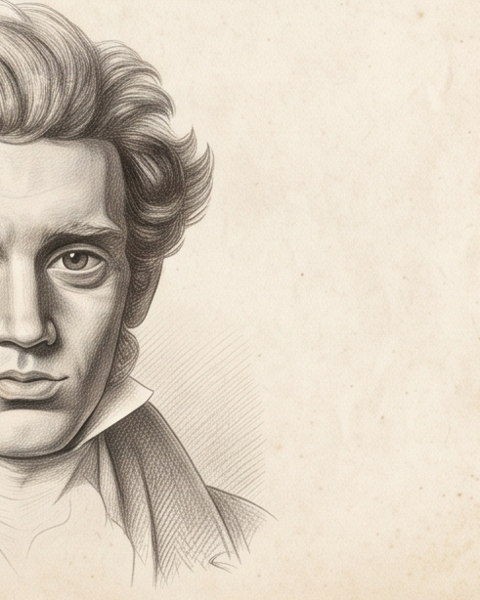
The root of this second anxiety reaches back to Kierkegaard. Anxiety in the philosophical sense is grounded in the human being's existential make-up; no trace of it is found in any other living creature. And precisely for that reason it cannot be silenced by medication or by technique alone — because its source is not an illness but being human. If what a person defines as their problem stems from their way of looking at life and relationships, applying only a technical treatment there is a waste of time; worse, it pushes the counselee into an illusion: the question stays where it was, only its voice has been turned down.
What does anxiety announce?

Existential philosophers take seriously the subjective experiences that surface when possibilities of decision, choice and action appear in a life: fear, anxiety, inner constriction, nausea. These are experiences that a reason-dominated gaze ignores, yet they belong to the human being's ontological make-up. Anxiety most often appears at the threshold of freedom: a real choice stands before us, and something is announcing it. We saw May's observation in the earlier essays: when a person grasps themselves as free and notices the richness of their possibilities, anxiety returns to ordinary proportions.
"These people need dialogue, not diagnosis."
— Lou Marinoff
An important line
This distinction is no belittling of treatment. Neurotic and pathological anxiety are real; clinical help — and, where needed, medication — can save lives. What the distinction points to is the other extreme: not every anxiety is an illness. To shelve an exam, a separation, a confrontation with death or a major decision under "illness" is to take away an experience that belongs to being human. And telling which anxiety calls for which kind of help is itself a matter of practical wisdom.
Dialogue instead of diagnosis
So what helps the anxiety that is born of life? Raabe's answer is clear: the philosophical counselor does not set out to diagnose the counselee from templates of normality and mental health. The session is not a process in which the counselee stays passive; they focus on questioning their life problems and take responsibility. Raabe calls this process philosophical therapy and explains it like this: therapy in the philosophical sense arises from the counselee's growing understanding, self-awareness and sense of well-being — all of which are the result of a careful exploration, together with a skilled philosopher, of themselves and the world around them.
A call
What might your anxiety be trying to tell you? Perhaps the first step is not to suppress it, but to listen.

Sources: Kierkegaard, S. (2017). The Concept of Anxiety · May, R. (2020). The Meaning of Anxiety · Marinoff, L. (2015) · Raabe, P. B. (2021). — Adapted from the fifth chapter of the author's doctoral dissertation in philosophy (Maltepe University, 2022).
← Journal