Journal · Dialogue & Method
How does Socratic dialogue work?

Not something for a coffee break
There is a scene Marinoff describes: a small group, a trained facilitator and a single question — "What is honesty?" Duration: roughly two days. It cannot be done over a coffee break; it takes the whole weekend. Why so long? Because what is sought is not an opinion but a definition.
Socrates' scene
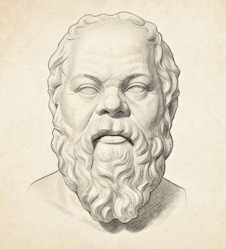
The method's name tells you its owner. For Socrates, philosophy was not a set of problems pondered in solitude; it was an activity carried on with others, through the different aspects and possibilities of a matter. Socrates confronts his interlocutors with the gap between their words and their deeds; the jolt this confrontation produces is the door that opens onto a more radical examination of one's own views. The aim is clear: to bring to light what the thing under discussion is, and to reach a definition made explicit. The road is clear too: to set out from personal experience, yet to seek the universal. Two tools serve this purpose — individual doubt and hard-won unanimity.
A modern birth: Nelson and Heckmann
The form practiced today under the name "Socratic Dialogue" was reforged in the twentieth century. The German philosopher Leonard Nelson (1882–1927) adapted the Socratic method to educational settings in the 1920s; his student Gustav Heckmann (1898–1996) carried the method on after Nelson's death and brought it to maturity (Farmer, 2019). The key to Nelson's approach is regressive abstraction: one sets out from a concrete example and traces back to the presuppositions on which the judgements in the example rest — general understanding develops through this movement backwards (Het Nieuwe Trivium, n.d.). The weekend-long group dialogues Marinoff describes are this tradition's child.
The steps of the method
Roughly, the dialogue proceeds like this: first the theme is explored and the fundamental question is formulated. Then examples are gathered from the participants' lived experience; one is chosen and analyzed. A definition is attempted on the strength of the example; counter-examples refute it; the definition is corrected and tested again. Sometimes the way forward is refutation, sometimes agreement — and when the dialogue closes, the problem thought through has become clear to its participants. You can watch this machinery at work step by step on this site: the Meno dialogue is the record of how Socrates pursued the question "can virtue be taught" with exactly this method.
"Justice, freedom or honesty may matter greatly to you — and you can still easily spend your entire life without ever knowing what exactly they mean."
— Lou Marinoff
Why it is not a mere technique
Here lies a crucial warning: if Socratic Dialogue is cut off from its root and reduced to a mere technique, it will not produce the expected effect. What carries the method is the depth behind it. Competence therefore demands two things: grasping the Dialogues Plato wrote by working through them again and again under an expert's guidance — and practicing extensively before moving to application. The warning that comes from the tradition of existential therapy is the same: torn from its philosophical root, what remains of the method is a question template, not a dialogue.
Why is it needed today?
Mussenbrock's observation is on the mark: philosophy's break with the practical confined it to particular topics and institutions and took away its capacity to be applied. Yet people feel pain, meaninglessness and loneliness in their lives — we are inside a general crisis of meaning and orientation. The desire for philosophy to become once more an activity that bends toward practical matters took concrete shape in the Western world with the spread of philosophy clinics and philosophy cafés. Kant's four questions still wait to be asked: What can I know? What ought I to do? What may I hope? What is the human being?
In the counseling room
In an individual process, the method looks like this: the counselor does not advise; they ask. Examples from the counselee's life come to the table; the definitions beneath the words are put to the test. What exactly is the thing you call "failure"? What do you mean by "a good relationship"? The aim is not to hand over the counselor's truth, but for the counselee to make their own concept explicit — dialogue instead of diagnosis, a definition instead of a prescription.
A call
Which is the word that governs your life yet you have never defined? To lay it on the table one evening is to try Socrates' inheritance.

Sources: Marinoff, L. (2015) · Mussenbrock, A. (2013) · Farmer, R. (2019). Learning Without Teaching: The Practice and Benefits of the Nelson–Heckmann Method of Socratic Dialogue · Heckmann, G. (1981). Das sokratische Gespräch: Erfahrungen in philosophischen Hochschulseminaren. Hannover: Schroedel · Het Nieuwe Trivium (n.d.). Socratic dialogue · Plato, Dialogues. — Adapted from the fifth chapter of the author's doctoral dissertation in philosophy (Maltepe University, 2022); current sources were used for the Nelson–Heckmann tradition.
← Journal